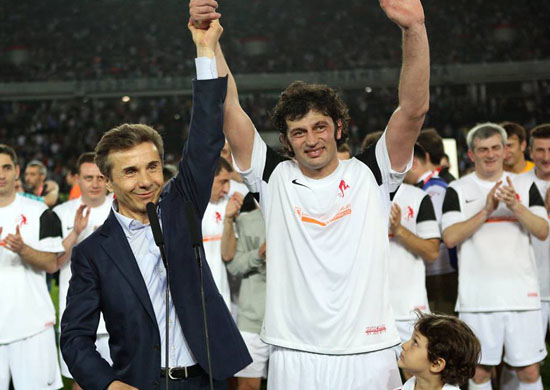
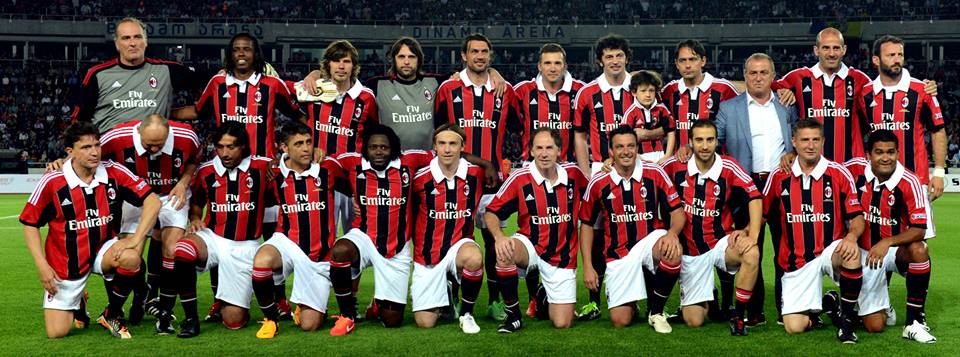
At the Dinamo Arena, home to Dinamo Tbilisi and often the Georgian national team, a team of old boys from AC Milan including hall of famers such as Baresi, Maldini and Inzaghi were pit against a curious assortment dubbed “Kaladze’s friends”. The latter comprised of former Georgian teammates such as Shota Arveladze and the now reluctantly mobile Giorgi Kinkladze as well as former Serie A opponents Luca Toni and Hakan Sukur.
Best known outside Georgia for featuring intermittently in the AC Milan defence of the 2000s, Kaladze is the most famous of any Georgian player in the post-Soviet era.But while this glitzy celebration of a career drew a capacity crowd, and was the talk of the khachapuri (cheese bread pie, a staple of the Georgian diet) stands for a few days, Kaladze’s assumed national hero status is under question.
However, ask local football fans to name their icons of Georgia’s independent football history, and you’ll hear the names of Kinkladze, Arveladze and current national head coach Temuri Ketsbaia long before they mention Kaladze, if indeed they ever do.
All three are attacking players, which perhaps gives them a natural advantage. Fans remember great goals, shots and dribbles rather than the tackles, blocks and clearances which comprise a defender’s important but less glorious duties.
During Milan’s victorious Champions League run in 2006/07, he started in only five of their thirteen fixtures and in the final against Liverpool he was brought on for the final ten minutes to reinforce the defence. Milan’s two-goal lead he had been sent on to protect was soon reduced to one but Milan held on.
That night in Athens served as an apt summary of his Milan career. Kaladze made a contribution, enough to earn a medal but little more.
In the campaign in which he featured most prominently, making 30 league starts in 2007-08, Milan finished fifth – their lowest Serie A placing in seven years.
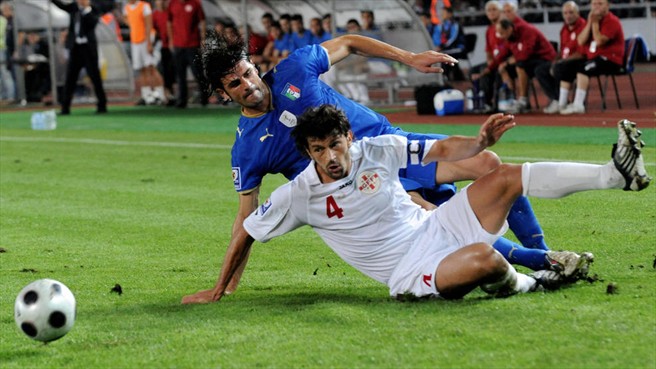
Even for the Georgian national side, many supporters would rather grumble about the two own goalshe scored against Italy in 2009, than praise his marshalling of the defence in a 1-0 win over Croatia in 2011 (arguably the country’s best ever result).
He retired at the end of the 2011/12 season, leaving Genoa for a life in politics having been taken under the wing of billionaire fledgling politician and now Prime Minister Bidzina Ivanishvili.
It is the latest chapter in what has been an eventful, and at times tragic, life of the footballer turned vice prime minister.
An athletic and composed left-back, Kaladze emerged at Dinamo Tbilisi before being signed at the age of 20 by Dynamo Kiev in 1998. Kaladze’s first season in Kiev, under the revered Valeriy Lobanovskyi (three-times coach of USSR), saw the Ukrainian champions reach the Champions League semi-finals, with Kaladze part of a defence which surrendered a 3-1 lead against Bayern Munich in Kiev in the first leg to draw 3-3. It proved costly as a Mario Basler goal helped Bayern to a decisive 1-0 win in the return leg, thereby denying the Ukrainians a place in the final against Sir Alex Ferguson’s Manchester United in Barcelona.
Two years later, with the Georgian now part of arguably the best team from the post-Soviet territory, his fame alerted some nefarious attention on the cusp of his high-profile move to Milan
Today Georgia, an increasingly popular tourist spot for skiers and wine-anoraks, is considered relatively safe for foreigners, tourists and locals alike. However, the status quo is a far cry from the “volatile and dangerous place” as experienced and described in the early 2000s by Jonathan Wilson inBehind the Curtain.
It was in 2001 that Kaladze’s brother Levan was kidnapped and after five years in which various versions are told of a ransom being paid or not paid, of reconciliation attempts being made or not made, he was officially pronounced dead in 2006 – a year after eight bodies had been discovered in the mountainous Svaneti region.
Even though four men are currently serving sentences for their part in the murder, Kaladze remains convinced others were involved in the killing and questions the guilt of those incarcerated.
At the time, Kaladze expressed his fury at the Georgian authorities’ lack of interest in the case, and even claimed that AC Milan owner Silvio Berlusconi was doing more than his own government.
In an interview with Tabula magazine earlier this year he vowed that “the investigation will be reopened in the future. No one can heal this wound while we are alive.”
From the Pitch to the Parliament
Kaladze hails from the transport hub town Samtredia in the western region of Imereti, and it was another man from the same region who enticed him into politics. He claimed that “the entry of Ivanishvili into politics stirred in me, like many citizens of our country, hopes about success.”
Now, history seems to be repeating itself to some degree. The reliable rather than spectacular sportsman has found himself in profitable, career-enhancing company much like he did at the San Siro.
Ivanishvili’s billions were earned not in Georgia but in neighbouring Russia, where he went into partnership with Jewish-Russian businessman Vitaly Malkin. Together they made billions from a number of sectors including banking, hotels and pharmaceuticals during days of high opportunism, and limited regulation, in first years of post-soviet Russia.
While the Georgian prime minister has generally kept a clean profile, his former business partner Malkin is surrounded by controversy.
For several years now, the Canadian government has accused Malkin of alleged money laundering and involvement in the international arms trade.
Ivanishvili had taken up citizenship in France, temporarily losing his Georgian citizenship as a result, before relocating to what Forbes described as his “art-filled fortress” in Tbilisi (his lavish home situated atop the Georgian capital’s hillside) and launching the “Georgian Dream” party to challenge the long-standing government of Mikheil Saakashvili.
The party name was supposedly inspired by the title of a song performed by his teenage albino rapper son Bera (more on him later) whose striking appearance and niche music, with absolutely no hint of nepotism, made him something of an icon as the “Georgian Dream” movement gathered pace in the summer of 2012.

No comments:
Post a Comment